
Skip to content

The 360 Series

Swiss inheritance law: who inherits without a will?

If no will or inheritance agreement is in place, Swiss law determines who inherits your estate and in what proportions. These statutory rules provide a clear framework. They do not, however, always reflect your personal wishes or the financial realities of the people closest to you. Understanding how Swiss inheritance law works is therefore an essential first step in deciding whether the legal distribution of your estate is truly aligned with your goals.​‌

Comprendre l’ordre successoral est la première étape pour savoir si la loi suffit ou si une planification successorale s’impose.
Episode 2/9
Épisode 2 sur 9

Who inherits your estate under Swiss law?​‌

Many people assume they already know who will inherit their wealth. Yet when they look more closely at the statutory rules, the outcome can differ significantly from what they expected.

Under Swiss inheritance law:

  • an unmarried partner does not inherit automatically;

  • siblings may be excluded entirely if closer relatives exist;

  • children may acquire immediate rights to part of the estate, even when the surviving spouse still depends on those assets; 

  • the statutory distribution does not consider the individual financial position of each heir.

The law does not attempt to identify the outcome that would be most appropriate for your family. It applies a predefined order based primarily on family relationships.

For relatively straightforward family situations, this framework may work well. For blended families, unmarried couples, business owners or families whose wealth is concentrated in real estate, the outcome may be quite different from what would have been intended.

How does the Swiss order of succession work?

Swiss inheritance law organises relatives into different lines of succession, known as parentelic lines.

The principle is simple: the closer the family relationship, the higher the priority to inherit.

As soon as heirs exist within one family line, the more distant lines are excluded. The order begins with descendants, followed by the parents and their descendants, and finally the grandparents and their descendants.

1st line of succession: descendants

The first line includes:

  • children;
  • grandchildren;
  • great-grandchildren.

Children are the primary heirs.

If a child has already passed away, that child's descendants inherit in their place according to the principle of representation.​‌ 

Example

Mr Martin passes away, leaving:

  • two children;
  • two siblings;
  • his mother.

His two children inherit the estate. His mother and siblings do not inherit because the presence of descendants excludes the second line of succession.
2nd line of succession: parents and their descendants

The second line applies only when the deceased leaves no descendants.

It includes:

  • parents;
  • siblings;
  • nieces and nephews.

The parents inherit first within this line. If one parent has already passed away, that parent’s share passes to their descendants, which include the deceased’s siblings or, where relevant, nieces and nephews.

Example

Claire passes away without a spouse, registered partner or children. Both of her parents are still living. They inherit her estate.

3rd line of succession: grandparents and their descendants

The third line applies only if there are no descendants and no heirs in the second line.

It includes:

  • grandparents;
  • aunts and uncles;
  • cousins.

The same principle applies: the closest generation within the line inherits before more distant descendants.

In practice, this line is less frequently involved because any descendants, parents, siblings, nieces or nephews would take priority.

What does a surviving spouse inherit?​‌

A surviving spouse or registered partner holds a special position under Swiss inheritance law.

Rather than belonging to a particular line of succession, the surviving spouse or registered partner inherits alongside descendants or heirs in the second line. The surviving spouse’s statutory entitlement therefore depends on which other relatives survive the deceased.

It is however important to distinguish this inheritance entitlement from the rights arising under the matrimonial property regime.

For a married couple, the matrimonial property regime is settled first. This determines which assets already belong to the surviving spouse. Only the assets forming the deceased spouse’s estate are then divided under inheritance law.

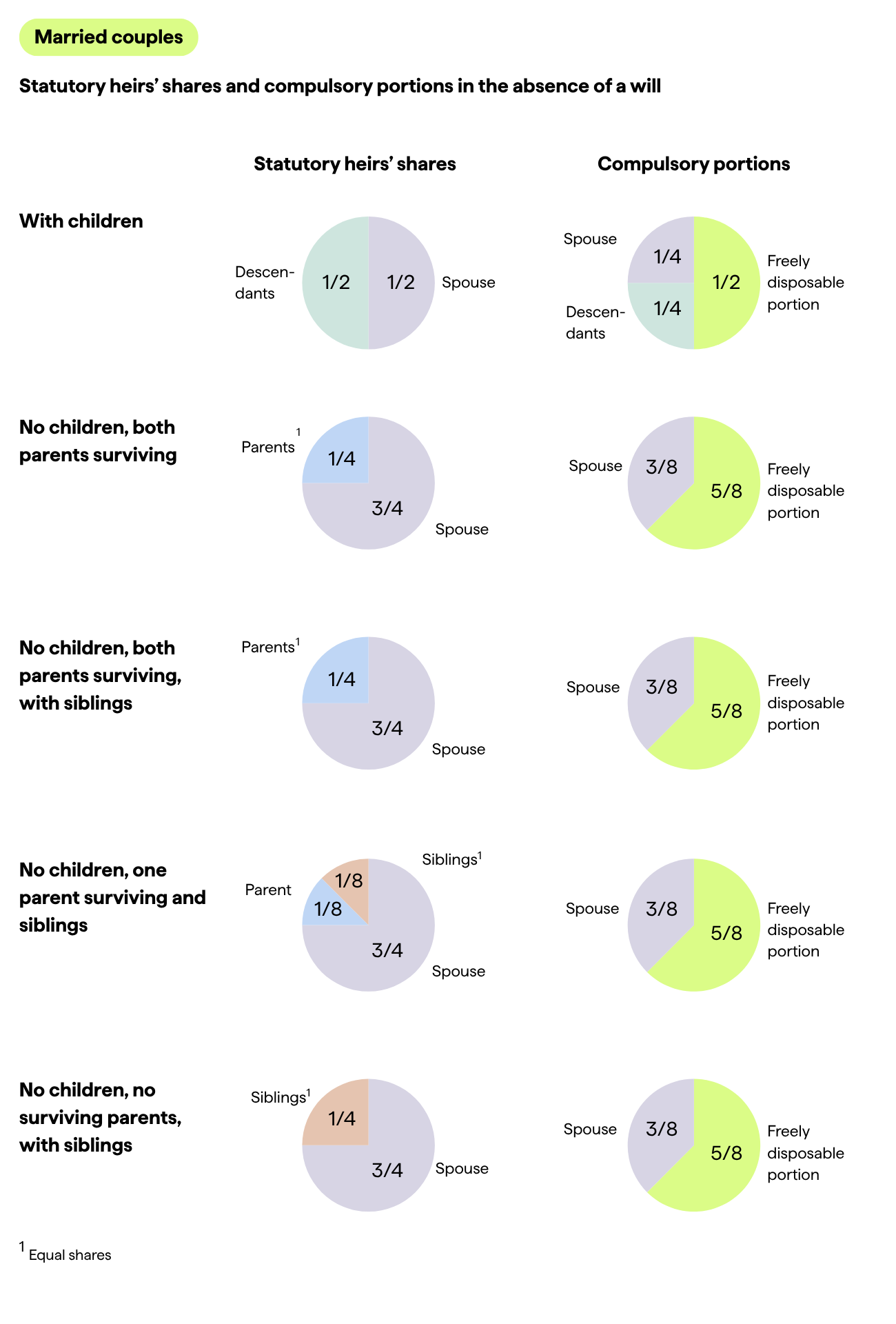
The surviving spouse may therefore receive assets under the matrimonial property regime in addition to the statutory inheritance share illustrated below.

  • Surviving spouse and children

    If the deceased leaves a spouse and one or more descendants, the estate is divided as follows:

    • 50% to the surviving spouse;
    • 50% to the descendants.

    Where there is more than one child, the descendants’ half is divided equally between them, subject to the rules of representation where a child predeceased the deceased.


    Simplified example

    Net estate: CHF 1 million

    Family situation:

    • a surviving spouse;
    • two children.

    Statutory distribution:

    • surviving spouse: CHF 500,000;
    • first child: CHF 250,000;
    • second child: CHF 250,000.

    This example concerns the estate alone. It does not represent the division of the couple’s entire combined wealth.

    Before the CHF 1 million estate can be determined, the matrimonial property regime must first be settled. Depending on the assets and the matrimonial regime involved, the surviving spouse may already have received a share of the couple’s property before inheriting from the estate.

    This distinction becomes particularly important when the family home represents a large proportion of the wealth. Although the surviving spouse may inherit half of the estate, the children also acquire immediate rights. If there is little liquidity available, additional planning may be required to allow the spouse to retain the home without having to sell important assets.

  • Surviving spouse, no children, but parents or siblings

    If the deceased leaves no descendants but does leave heirs in the second line of succession, the statutory distribution is:

    • 75% to the surviving spouse;
    • 25% to the heirs in the second line​‌ of succession


    Simplified example

    Net estate: CHF 1 million

    Family situation:

    • a surviving spouse;
    • the deceased’s mother;
    • no children.

    Statutory distribution:

    • surviving spouse: CHF 750,000;
    • mother: CHF 250,000.

    This rule can surprise couples without children who assume that the surviving spouse will automatically inherit the entire estate.

    Once again, the example relates only to the assets that form the estate after the matrimonial property regime has been settled.

  • Surviving spouse with no heirs in the first two lines

    If there are no descendants and no heirs in the parental line, the surviving spouse inherits the entire estate.

    Relatives in the grandparental line do not inherit alongside the spouse in this situation.

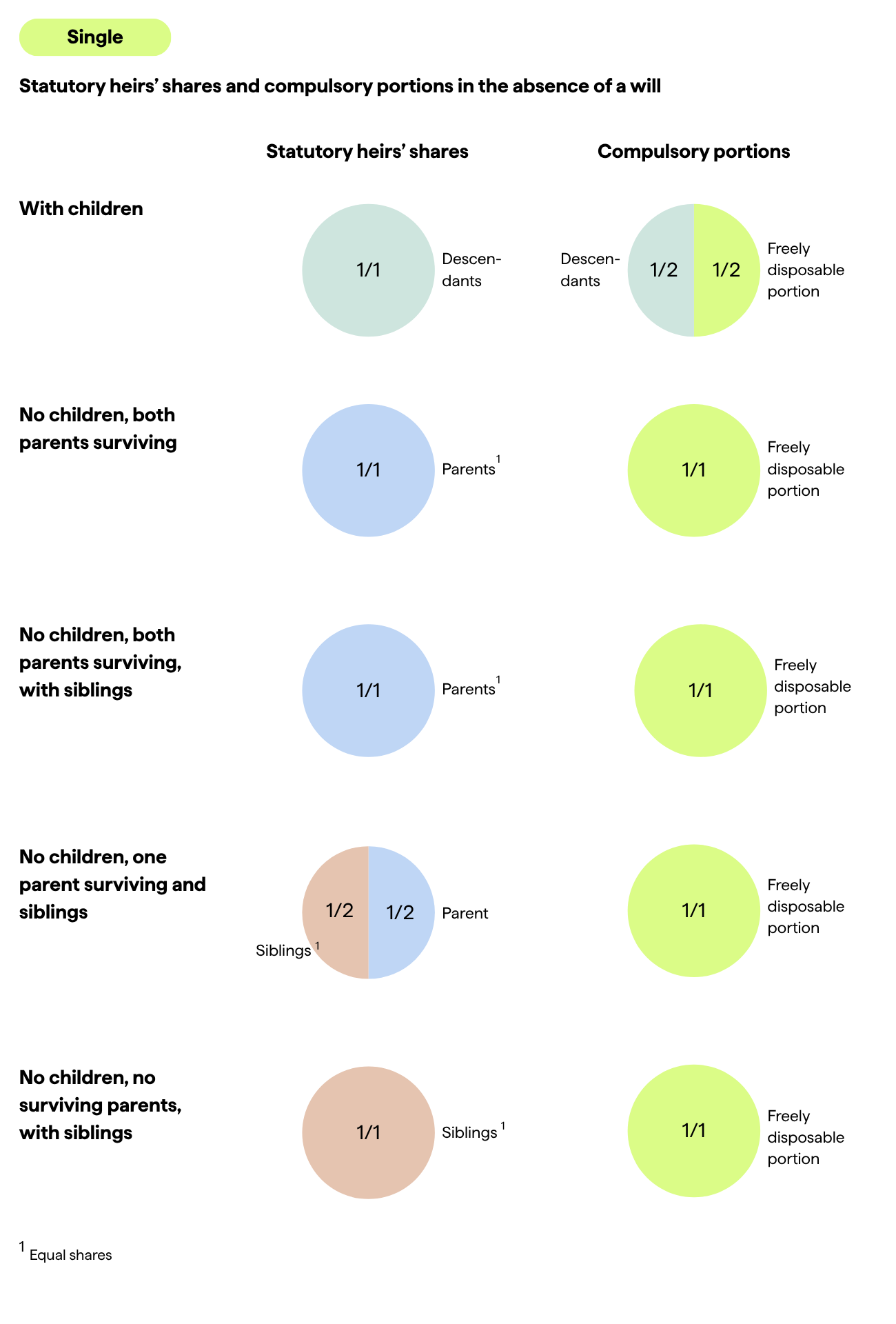
Who inherits if you are single?

For the purposes of statutory inheritance, being single includes a person who is neither married nor in a registered partnership.

A person may still have lived with a long-term partner for many years. However, cohabitation alone does not give that partner the same statutory rights as a spouse or registered partner.

  • Single with children

    If a single person leaves descendants, the descendants inherit the entire estate. 


    Example

    Net estate: CHF 900,000

    Family situation:

    • no spouse or registered partner;
    • three children.

    Each child receives CHF 300,000, assuming all three children are living and no representation rules need to be applied.

    If one child predeceased the deceased and left descendants, those descendants collectively take their parent’s place.

  • Single without children

    If there are no descendants, the estate passes to the second line of succession:

    • first to the parents;
    • if a parent has passed away, to that parent’s descendants;
    • then, where relevant, to siblings, nieces and nephews.

    If there are no heirs in the second line, the third line may inherit.

  • Single with no statutory heirs

    If no heir exists within any of the three family lines, the estate ultimately passes to the canton or municipality determined by the Swiss law.

    Someone without close family may therefore wish to consider whether the statutory outcome reflects their intentions.

    A will may allow them to leave their wealth to friends, godchildren, a charitable organisation or another beneficiary of their choice, subject to the applicable legal framework.

Does an unmarried partner inherit in Switzerland? 

No.

An unmarried partner has no automatic inheritance rights under Swiss law, even after many years of living together. 

Example

Marc and Sophie have lived together for 20 years. They are not married and have not entered into a registered partnership.

Marc passes away without a will or inheritance agreement.

Sophie does not automatically inherit from Marc’s estate. His wealth is distributed among his statutory heirs according to the order laid down by law.

The length of the relationship does not, by itself, change this position.

If Marc wished to provide for Sophie, specific planning would be required. Depending on the wider circumstances, this might involve:

  • a will assigning all or part of the freely disposable portion to Sophie;

  • an inheritance agreement;

  • appropriate pension beneficiary designations;

  • life insurance;

  • arrangements concerning jointly owned property.

The legal, pension and tax implications should be reviewed together. Providing for an unmarried partner through a will does not necessarily give the partner the same tax or pension position as a spouse.

Protected heirs

What is a compulsory portion?​‌

A will does not always give you complete freedom to distribute your estate as you choose.

Swiss inheritance law protects certain close heirs through compulsory portions, also described internationally as forced heirship rights.

The compulsory portion is the minimum share of an estate that heirs may remain entitled even when a will or inheritance agreement provides for a different distribution. It should not be confused with the statutory inheritance share.

The statutory inheritance share is what an heir receives when there is no will or inheritance agreement modifying the legal distribution.

The protected heirs are:

  • descendants;

  • the surviving spouse;

Since 1 January 2023:

  • descendants are entitled to a compulsory portion equal to 50% of their statutory share;

  • the spouse or registered partner retains a compulsory portion equal to 50% of the statutory share;

  • parents no longer benefit from a compulsory portion.‌


Free allocation

What is the freely disposable portion?​‌

The freely disposable portion is the share of the estate that remains once compulsory portions have been taken into account.

This is the part that can generally be allocated according to the testator’s wishes.

It may be left to:

  • the surviving spouse;

  • one or more children;

  • an unmarried partner;

  • a stepchild;

  • another family member;

  • a friend;

  • a charitable organisation.

The 2023 reform reduced the compulsory portion of descendants and abolished the compulsory portion of parents. This increased the flexibility available for estate planning. In a situation involving a spouse and descendants, up to 50% of the estate may now be freely allocated, subject to the precise circumstances and the validity of the arrangements made.

If a person has no protected heirs, the entire estate may generally be freely allocated through appropriate testamentary arrangements.


When may the statutory order of succession be insufficient?​‌

The statutory order of succession provides a default framework. It is not a personalised estate plan.

Additional planning may be particularly important if:

  • you live with an unmarried partner;

  • you have a blended family;

  • your wealth is mainly invested in real estate;

  • one child is expected to take over a family business

  • you wish to provide for someone who is not a statutory heir;

  • you would like to support a friend or charitable organisation;

  • assets are held in more than one country;

  • preserving family control over a particular asset is important.

In these situations, the central question is not simply who inherits.

It is also whether sufficient liquidity is available, whether a property can be retained, whether the surviving spouse or partner will remain financially secure and whether the intended distribution can be implemented without placing unnecessary strain on the family.

A will, inheritance agreement, matrimonial property arrangement, life insurance policy or pension beneficiary designation may help address different parts of the situation.

The value lies in coordinating these instruments rather than relying on one in isolation.

Key takeaways

Swiss inheritance law follows a clear order of succession.
Descendants inherit first, followed by parents and their descendants, then grandparents and their descendants.

Unmarried partners do not inherit automatically.
Specific planning arrangements may be required if you wish to provide for a long-term partner.

The 2023 reform offers greater estate planning flexibility.
Reduced compulsory portions mean that a larger share of an estate can now be allocated according to your wishes.

Let's talk about your legacy

Understanding what the law provides is an important first step. Determining whether it reflects your wishes is equally important.

Every family has its own history and priorities. Our specialists help you build an estate plan that protects your loved ones and reflects what matters most to you.

In the next episode

Before an estate can be divided, it is necessary to determine which assets already belong to the surviving spouse.

The next episode explores the role of the matrimonial property regime, the differences between participation in acquired property, separation of property and community of property, and the impact each regime may have on the wealth ultimately included in the estate.

FAQ

Frequently asked questions about Swiss inheritance law

The 360 Series

The "Estate Planning in Switzerland" series

Turning life’s ambitions into lasting legacies.

This 360 series provides the essential insights you need to understand estate planning in Switzerland, helping you protect your loved ones and transfer your wealth with confidence.

  • Episode #1

    Estate planning in Switzerland: protecting and transferring your wealth

    Why plan your estate and protect the people who matter most?

  • Episode #2

    Swiss inheritance law

    Who will inherit your assets if there is no will?

  • Episode #3

    Matrimonial property regime and inheritance

    What belongs to your spouse before the estate is divided? 

  • Episode #4

    Wills and inheritance agreements

    How can you organise your estate according to your wishes?

  • Episode #5

    Lifetime gifts and advancements on inheritance

    How can you transfer wealth during your lifetime while preserving fairness among your heirs?

  • Episode #6

    Pension assets and life insurance

    How can you protect your loved ones through pension planning, Pillar 3a and life insurance?

  • Episode #7

    Complex succession situations

    How can you protect your family, your cohabiting partner or your business?

  • Episode #8

    Inheritance and gift tax

    Which taxes apply, and why do they vary from canton to canton?

  • Episode #9

    Planning your estate in five steps

    A five-step method to help you plan the transfer of your estate with peace of mind.

The information presented in this series is provided for general information purposes only and does not constitute personalised legal, tax or wealth planning advice. Family, financial and tax circumstances vary, and the implications of an inheritance or wealth transfer may differ significantly from one situation to another. Before making any decision, you should seek advice from a qualified specialist who can assess your individual circumstances. ​

A unique blend

A life project is not something you share with just anyone.

Dedicated experts in every field.

  • Private banking

    Investment

    From investment advice to delegated portfolio management, we are dedicated to safeguarding your capital and securing its growth by identifying investment solutions that align seamlessly with your values, goals, and the assurance of peace of mind.

  • Private banking

    Wealth & Pension
    advice

    Bring vitality and success to your life projects by comprehensively analyzing your assets and optimizing their structure.

  • Private banking

    Financing

    We offer various financing solutions for all your real estate projects, such as mortgages and Lombard loans.

Piguet Galland & you

Piguet Galland DNA

More than a friend,
a Piguet Galland private banker.

To provide you with the best possible support, we want to understand what keeps you awake at night, your plans, and your dreams. Our expertise lies in aligning your assets with projects close to your heart.​‌

Your trusted partner

We understand that you expect more from us than trust and expertise. Above all, you want peace of mind for both the future and the present. It's our responsibility to deliver.​‌

romands et proches de vous

French-speaking and close to you

Because we are close to you, where you need us, and available when you need us, we conduct our wealth management business with agility and efficiency and always with a smile.

Piguet Galland soutenue par la BCV

A human-scale bank backed by a solid financial group

Our majority shareholder, Banque Cantonale Vaudoise, is one of the few major banks in the world without a state guarantee, and it holds an AA rating from Standard & Poor's. This is concrete proof of our results.

Meet a specialist

Your time is precious, and we're committed to making this process as smooth as possible.