Case study
Building a coherent succession strategy: from theory to practice

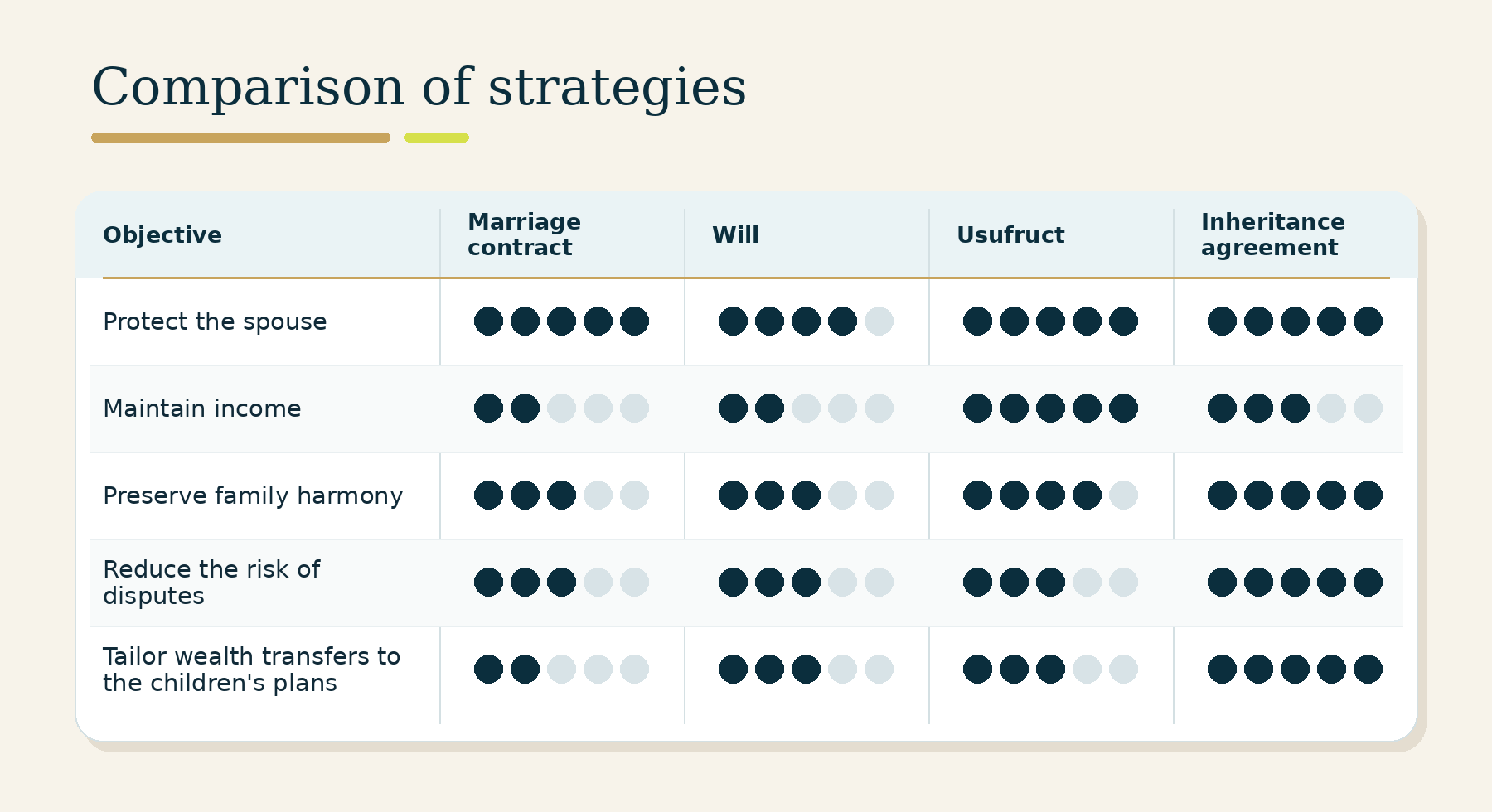
The objective is not to find a single solution, but rather to combine several legal and wealth planning tools in order to simultaneously address the goals of protecting the surviving spouse, ensuring fairness between the children, and preserving the family's wealth.
In the case under review, no individual measure can achieve all of these objectives on its own.
It is the coordination of the various planning tools that delivers the most effective outcome.
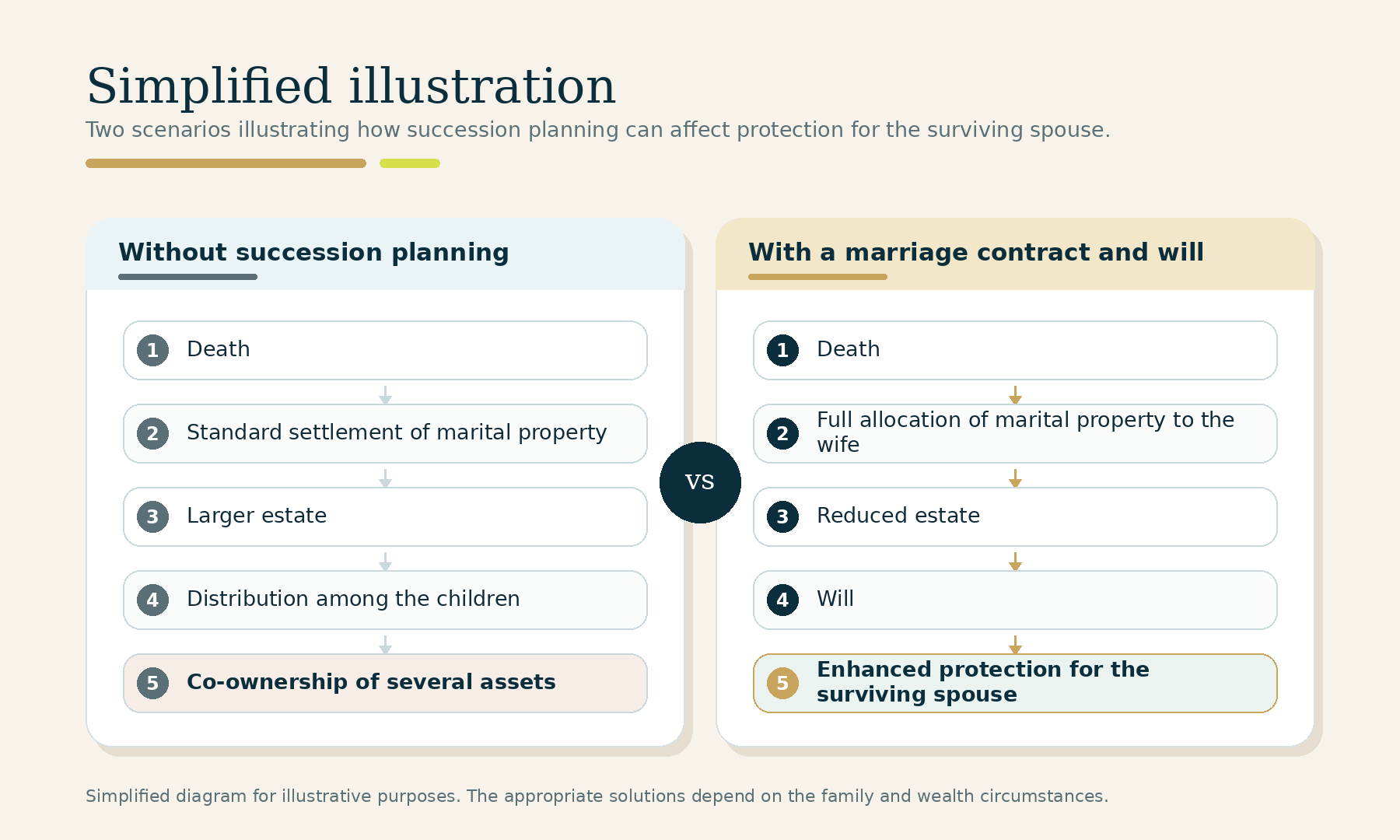
Scenario A – No succession planning
Let us assume that the husband passes away without having modified the matrimonial property regime or put any estate planning arrangements in place.
In this scenario:
-
the matrimonial property regime is settled according to the standard rules governing participation in acquired property;
-
only the husband's share of the marital property is included in his estate;
-
the inherited assets classified as separate property are included in the estate in their entirety;
-
the estate is then distributed in accordance with the default legal provisions.
Although the wife is a legal heir, she could quickly find herself in a co-ownership arrangement with the children over certain assets, particularly the inherited property or part of the investment portfolio.
While this situation does not prevent effective wealth management, it can significantly reduce the surviving spouse's freedom to make decisions.
For example:
-
selling a property;
-
rebalancing an investment portfolio;
-
financing long-term care accommodation;
-
making future gifts to grandchildren.
All of these decisions could require the agreement of the other co-owners.
Key risks
Without proper planning, several challenges may arise:
-
reduced flexibility for the surviving spouse;
-
family co-ownership arrangements that may be complex and time-consuming to manage;
-
the risk of having to sell assets under unfavourable market conditions;
-
difficulties in respecting the parents' wishes regarding gifts already made during their lifetime.
Scenario B – Marriage contract and will
The couple decides to:
-
enter into a marriage contract providing for the full allocation of marital property to the surviving spouse;
-
prepare a will using the disposable portion of the estate for the benefit of the wife.
This combination fundamentally changes the situation:
-
before the estate is even opened, the wife receives all of the marital property;
-
the husband's estate therefore consists primarily of his separate property;
-
the will can then be used to allocate the disposable portion of the estate to the wife while respecting the children's statutory entitlements.
As a result, a larger share of the family's wealth remains under the control of the surviving spouse, making it easier to manage throughout retirement.

The benefits of usufruct
In some families, parents wish to transfer ownership of part of their assets to their children immediately while ensuring that the surviving spouse retains the financial security they need.
In such circumstances, usufruct rights can be a particularly attractive solution.
Under this approach:
-
the children become the bare owners of the assets;
-
the wife retains the economic use of those assets;
-
she continues to receive the income generated by the relevant investments or properties.
This approach often makes it possible to reconcile two objectives that may appear contradictory:
-
transferring legal ownership of wealth to the children;
-
preserving the surviving spouse's financial independence.
It is particularly well suited to situations where a significant portion of the family's wealth is invested in income-generating assets.
Why an inheritance agreement deserves consideration
For many families, a will is a sufficient planning tool. The case under review, however, presents a particular set of circumstances.
Both children are:
-
adults;
-
financially responsible, or on the path to becoming so;
-
fully aligned with their parents' wish to protect their mother;
-
supportive of achieving long-term economic fairness.
These factors make it possible to consider entering into an inheritance agreement.
Benefits of an inheritance agreement
-
it formalises family agreements;
-
it strengthens the legal certainty of the arrangements put in place;
-
it reduces the risk of future disputes;
-
it facilitates coordination with gifts already made during the parents' lifetime.
It is often an excellent family governance tool when the interests of all family members are aligned.
Point to consider – An inheritance agreement is not a substitute for family dialogue
Experience shows that the most successful succession strategies are built first and foremost on open and transparent communication between generations.
Legal tools can formalise decisions, but they cannot replace family discussions. Clearly explaining the reasons behind the choices that are made can significantly reduce the risk of future conflicts.

Your situation deserves a tailored approach
Do you have questions about protecting your spouse, ensuring fairness between your children, or transferring your wealth? Our specialists guide you through the process and help you build a strategy tailored to your needs.
“An effective succession plan is not about finding the “perfect” legal instrument. Rather, it relies on combining several complementary tools tailored to the structure of the family's wealth, the composition of the family, and the objectives being pursued. It is this holistic approach that makes it possible to provide lasting protection for the surviving spouse while preserving fairness across generations.”
Annabelle Guitton Wealth Planning Specialist
In the next episode
Beyond succession law, the questions that most often arise in practice concern lifetime gifts, their fairness, documentation, and governance.
Discover how you can support your children without creating inequalities.
How can you protect your spouse while supporting your children during your lifetime without compromising long-term fairness?
Planning your succession is ultimately about protecting the people who matter most and providing a clear direction for your family's wealth.
Through this case study, discover how our specialists help clients navigate succession planning and build wealth transfer strategies aligned with their family's long-term objectives.
Explore the full case study below, presented as a series of episodes.
-
Summary
Case study: protecting your spouse while supporting your children
An overview of our case study, including the clients' profile, the challenges they faced, and the key issues at stake.
-

Episode #1
Case overview and family considerations
Spouse protection, support for children, and family fairness: discover the foundations of this case study.
-

Episode #2
The first succession planning decisions
Discover why the matrimonial property regime is often the first and most effective way to protect a surviving spouse.
-

Episode #3
Tools to protect your spouse
Marriage contract, will, usufruct rights, or an inheritance agreement: discover the key planning tools available to help protect a surviving spouse.
-

Episode #4
Building the right succession strategy
Compare different planning strategies and their impact on spouse protection, children's interests, and long-term family balance.
-

Episode #5
Supporting your children without creating inequalities
Lifetime gifts, advancements on inheritance, and family loans: how can you support your children when they need it most while preserving long-term economic fairness between heirs?
-

Episode #6
Frequently asked questions and key takeaways
Explore the key insights from this case study and find answers to some of the most common questions about succession planning.

Academy
-

Wealth solutions
Build, grow, and preserve your wealth.
-
Pension planning
All you need to know about pension planning for people and for businesses.
-

Financing
Financing options for your real estate project.
-

Investment
Resources to learn the fundamentals of investment or to specialize.