Case study
Organising wealth transfers fairly
Succession planning is not only about structuring the transfer of wealth upon death.
It also makes it possible to support children when their financial needs are greatest, without compromising long-term family harmony.

In this case study, the two children have very different plans and priorities:
-
the son is planning to purchase his primary residence in the near future;
-
the daughter intends to establish her own medical practice in approximately five years.
The couple is not seeking equality in terms of timing, but rather long-term economic fairness.
This distinction is essential.
Chronological equality or economic fairness?
Many parents believe they should support their children in exactly the same way and at the same time.
In reality, financial needs arise at different stages of life.
Fairness does not necessarily mean giving each child the same amount today. Rather, it means providing each child with support that reflects their specific needs while ultimately ensuring equal treatment in terms of wealth transfer.
In the case under review:
-
the son could receive financial assistance in the near future to help fund the equity contribution required to purchase a home;
-
the daughter could receive equivalent support when she establishes her medical practice.
A difference in timing is not a problem, provided it is properly anticipated and planned for.
Long-term economic fairness
The principle adopted by the family is straightforward:
Each child should ultimately receive an equivalent economic benefit, even if financial support is provided at different stages of their lives.
This philosophy often represents the best balance between fairness and effective wealth planning.
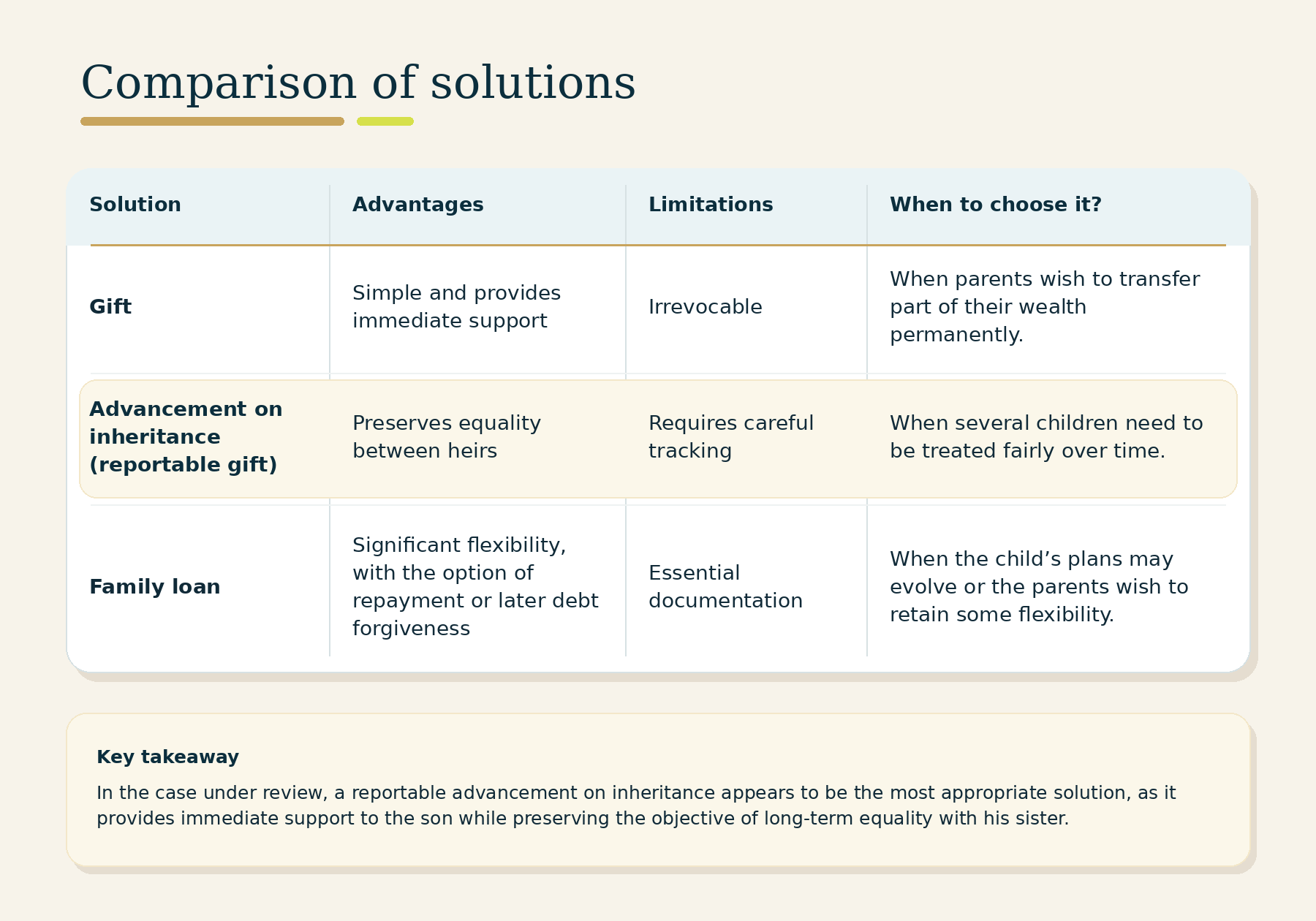
Lifetime gift, advancement on inheritance, or family loan?
There are several ways to provide financial support to a child. The most appropriate option will depend on the objective being pursued, the desired degree of flexibility, and the parents’ intentions.

Why should every lifetime gift be formally documented?
Experience shows that inheritance disputes rarely arise because of the amount of a gift. More often, they result from a lack of documentation.
Ideally, any significant lifetime gift should clearly specify:
- the date of the transfer;
- the amount;
- the beneficiary;
- the purpose of the gift;
- whether it should be taken into account when settling the estate;
- any planned equalisation arrangements.
This documentation helps protect the entire family.
Point to consider – Lifetime gifts should not rely solely on family memories
Many years, or even decades, may pass between a gift being made and the settlement of an estate. Memories differ, supporting documents may be lost, and amounts are sometimes forgotten.
Clear documentation is often the most effective way to prevent future family disputes.
Should lifetime gifts be indexed?
The case under review raises a particularly interesting question.
Let us assume that:
-
the son receives CHF 600,000 today to purchase a home;
-
the daughter receives CHF 600,000 in five years' time to fund the establishment of her medical practice.
In nominal terms, the amounts are identical. In economic terms, however, this may no longer be the case.
Depending on the circumstances, several approaches may be considered:
-
equalisation based on nominal value;
-
indexation to inflation;
-
indexation to a financial benchmark agreed upon by the parties;
-
taking into account the actual return generated by the funds.
The appropriate approach depends on the family's objectives and should be discussed openly among all family members.
There is no universal solution.
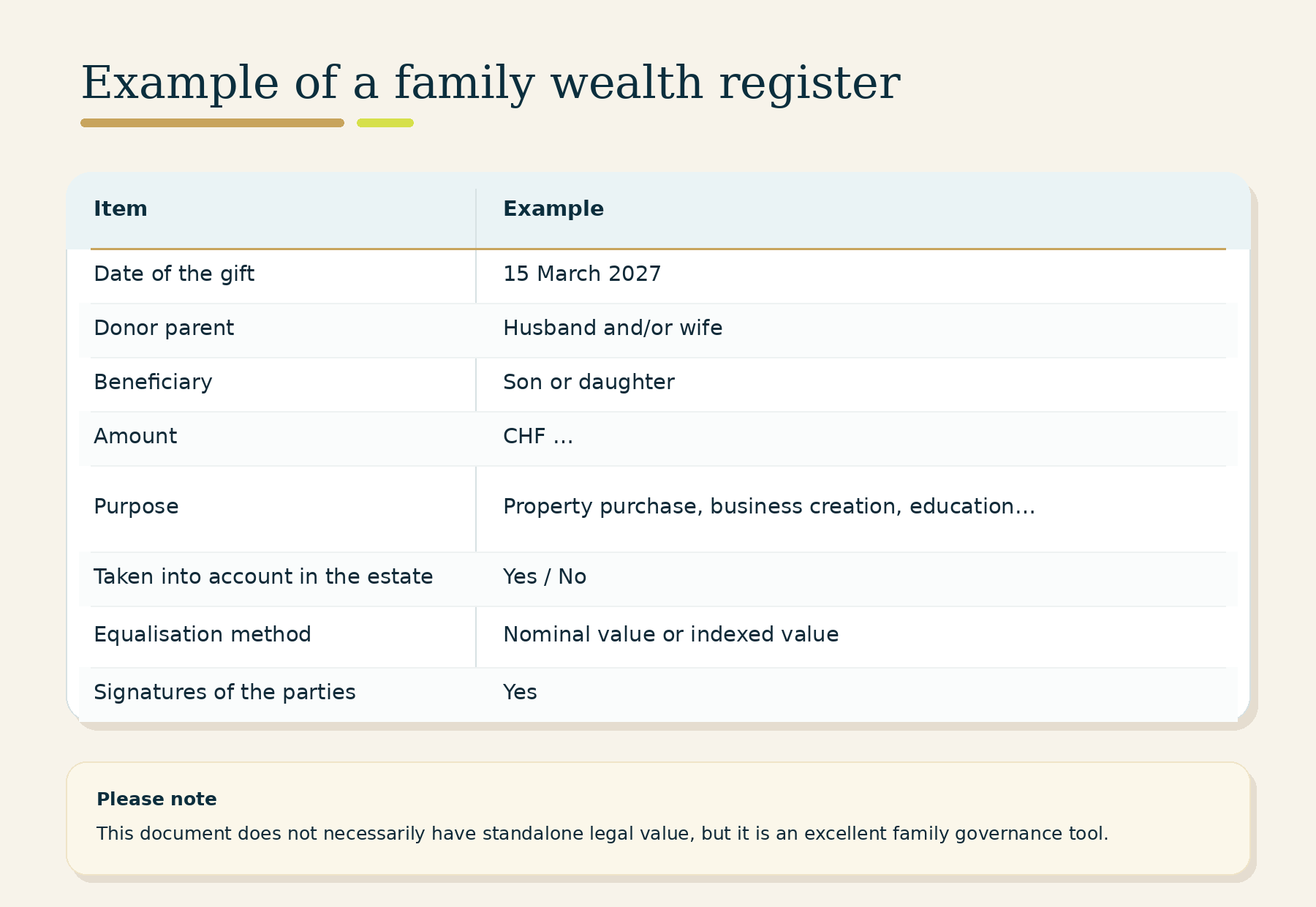
Family wealth register
To ensure full transparency, our specialists often recommend maintaining a family wealth register to record lifetime transfers. This register may include, among other things, the information listed below.

A family charter can complement formal legal arrangements
In addition to a marriage contract, a will, or an inheritance agreement, some families choose to formalise their wealth transfer principles in a family charter.
Without replacing formal legal documents, this type of agreement can be used to set out:
- the objectives pursued by the parents;
- the principles of fairness adopted by the family;
- the method used to calculate equalisation between children;
- the rules governing future gifts.
This approach promotes transparency and encourages dialogue across generations.
Tax considerations to anticipate
In the case under review:
- the parents reside in the Canton of Vaud;
- the daughter also resides in the Canton of Vaud;
- the son resides in Geneva.
As a general rule, gifts of movable assets are subject to the legislation applicable at the donors’ place of residence. The recent increase in tax thresholds in the Canton of Vaud provides greater flexibility when planning substantial lifetime gifts.
However, a wealth planning strategy should never be driven solely by tax considerations. Civil, family, and succession planning objectives should always remain the primary focus.
Important note: Tax rules may change over time. Any significant lifetime gift should therefore be reviewed in light of the legislation and administrative practice in force at the time it is made.

Analysis from Piguet Galland specialists
For families with significant wealth, lifetime gifts are not simply a way of anticipating succession. More importantly, they allow financial support to be provided at the moment when it creates the greatest value for the beneficiaries.
A well-designed strategy is generally built around three key principles:
-
Fairness
By ensuring that each child ultimately benefits from equivalent economic support.
-
Transparency
Through clear documentation of gifts and the principles governing them.
-
Flexibility
In order to adapt the strategy to changes in the family's circumstances, wealth situation, or tax environment.
The objective is not to achieve strict equality at every stage, but rather to ensure that, over the long term, each child benefits from economically equivalent treatment.
A tailored approach to your situation
Spouse protection, wealth transfer, lifetime gifting, and tax planning: benefit from expert guidance to turn your family's goals into a coherent wealth planning strategy.
“A successful lifetime gift is not measured solely by the amount transferred. It is measured by its ability to meet the right need, at the right time, while preserving long-term family harmony. Transparency and proper documentation are often the best safeguards for a smooth and successful wealth transfer.”
Annabelle Guitton Wealth Planning Specialist
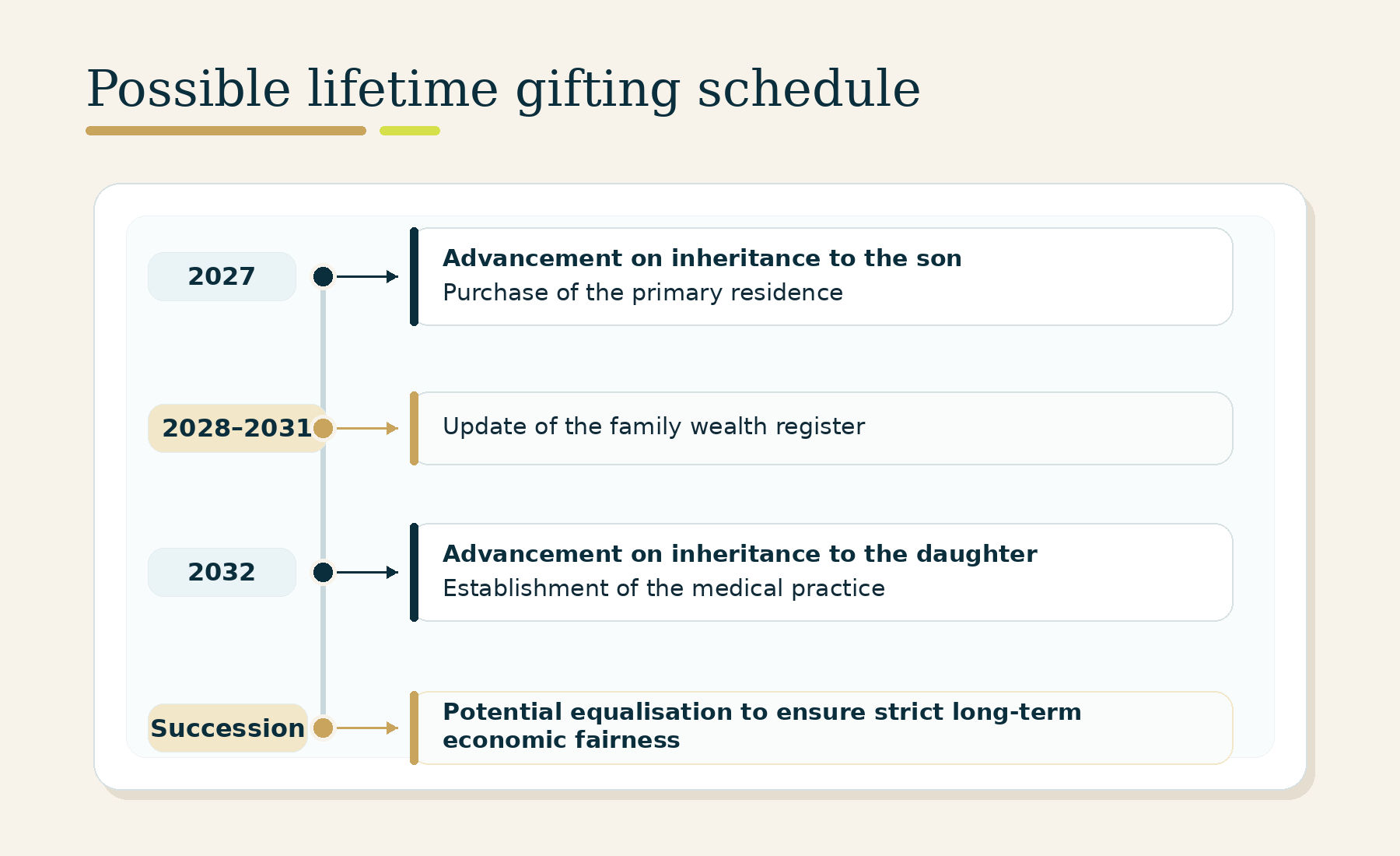
A ten-year wealth planning roadmap helps ensure consistent oversight and effective implementation of a comprehensive wealth planning strategy.
For example:
-
2026: Wealth review and asset classification analysis.
-
2027: Execution of the marriage contract.
-
2027: Preparation of the will.
-
2028: First advancement on inheritance.
-
2032: Second lifetime gift.
-
Every 3 to 5 years: Review of the succession planning strategy.
In the next episode
Find answers to the most frequently asked questions about succession planning in Switzerland, along with the key takeaways from this case study.
How can you protect your spouse while supporting your children during your lifetime without compromising long-term fairness?
Planning your succession is ultimately about protecting the people who matter most and providing a clear direction for your family's wealth.
Through this case study, discover how our specialists help clients navigate succession planning and build wealth transfer strategies aligned with their family's long-term objectives.
Explore the full case study below, presented as a series of episodes.
-
Summary
Case study: protecting your spouse while supporting your children
An overview of our case study, including the clients' profile, the challenges they faced, and the key issues at stake.
-

Episode #1
Case overview and family considerations
Spouse protection, support for children, and family fairness: discover the foundations of this case study.
-

Episode #2
The first succession planning decisions
Discover why the matrimonial property regime is often the first and most effective way to protect a surviving spouse.
-

Episode #3
Tools to protect your spouse
Marriage contract, will, usufruct rights, or an inheritance agreement: discover the key planning tools available to help protect a surviving spouse.
-

Episode #4
Building the right succession strategy
Compare different planning strategies and their impact on spouse protection, children's interests, and long-term family balance.
-

Episode #5
Supporting your children without creating inequalities
Lifetime gifts, advancements on inheritance, and family loans: how can you support your children when they need it most while preserving long-term economic fairness between heirs?
-

Episode #6
Frequently asked questions and key takeaways
Explore the key insights from this case study and find answers to some of the most common questions about succession planning.

Academy
-

Wealth solutions
Build, grow, and preserve your wealth.
-
Pension planning
All you need to know about pension planning for people and for businesses.
-

Financing
Financing options for your real estate project.
-

Investment
Resources to learn the fundamentals of investment or to specialize.